Booking choice: The 2-day sunrise climb from Tokyo, ★ 5.0 (5). Check dates Compare the options below
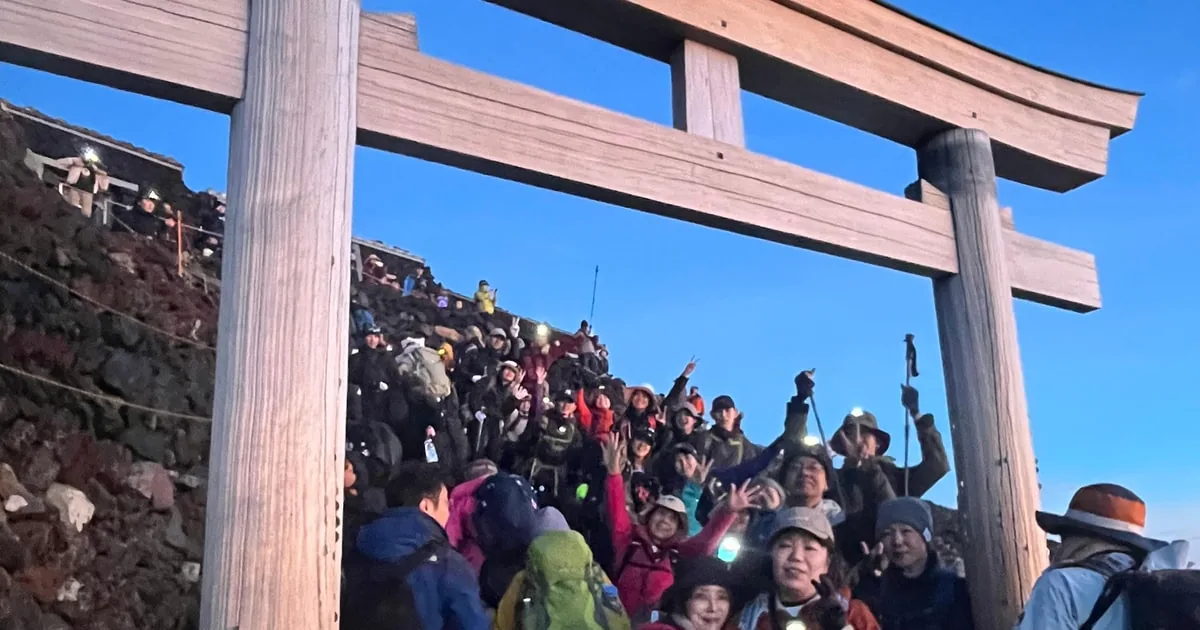
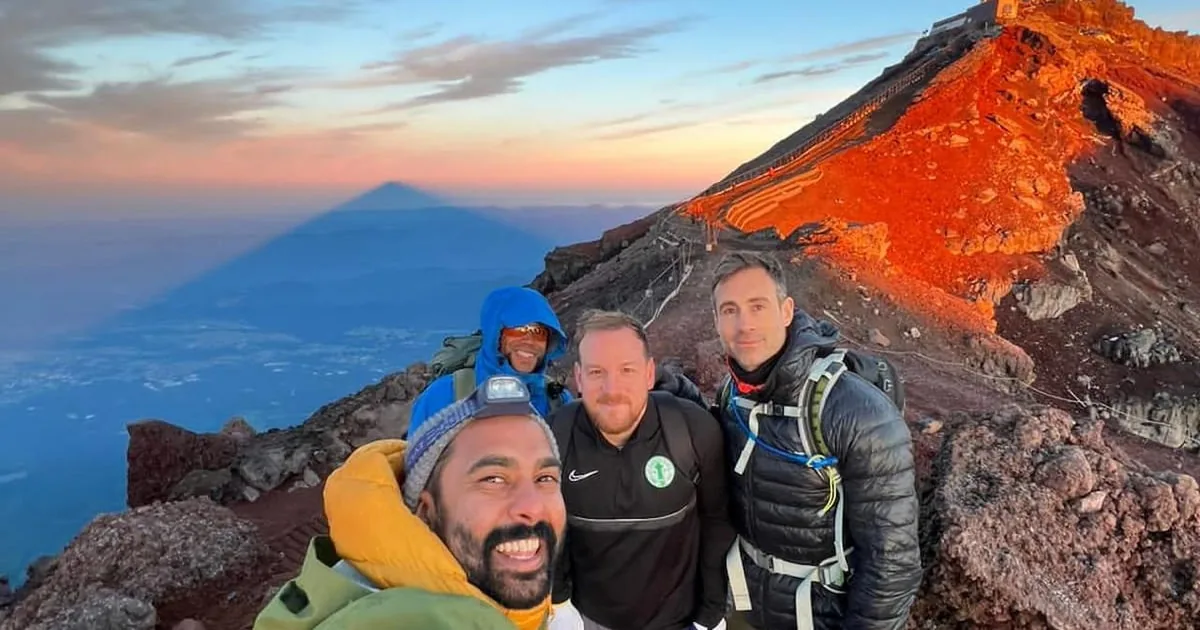
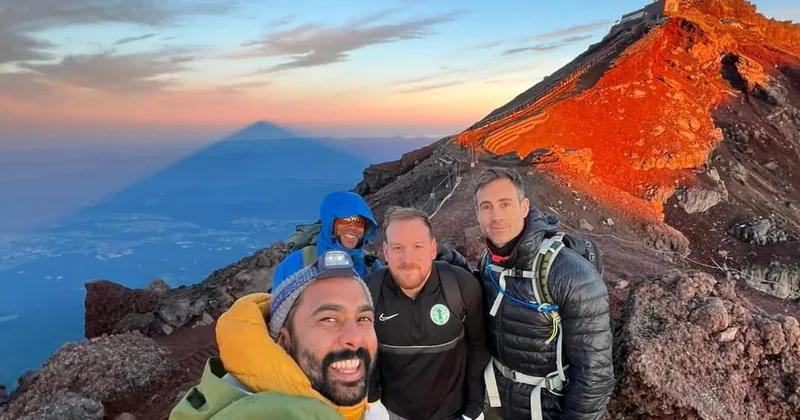
The classic Fuji climb takes two days and one short night. You walk up through the afternoon, eat an early dinner in a hut, sleep a few hours, and set off again in the dark with a line of headlamps above you. At about half past four the sky turns orange over the clouds, and the whole trail stops to watch.
This guide covers whether a one-day climb makes sense, how the huts work, where to watch the sunrise, a sample two-day timetable, how cold it gets at the top, the descent and the crater walk, and when a guided sunrise climb is worth it. The rules that shape all of this, from the 14:00 gates to the fee, are in the rules and season guide. The 2026 season has ended, so anything you plan now is for next summer.
The quick answer
A one-day climb is allowed if you pass the 5th station gate between 03:00 and 14:00, but it is not recommended: most people need a hut night to adjust to the altitude. Huts are booked separately from the trail entry, are very crowded in peak season, serve a simple dinner and breakfast, and turn the lights out early. Summer sunrise is about 4:30 to 5:00; you can watch it from the 8th or 9th station or from the summit, where it gets crowded just below the top before dawn. The summit averages 5.3 °C in July and 6.4 °C in August, and it is close to 0 °C before sunrise. Descents take about 2 hours 40 minutes to 3 hours 35 minutes by official estimates. The crater walk takes about 1 to 1.5 hours and closes in wind, fog or snow.
Can I climb Fuji in one day?
Yes, if you start after 03:00 and pass the 5th station gate before 14:00, but it is not recommended. Climbing about 1,300 to 2,300 m and coming straight back down in one day leaves your body no time to adjust, and most people are far more comfortable with a hut night.
A one-day climb means an early start, around 6 to 9 hours up depending on the trail, and 3 hours or more down, all at a steady pace. Fit hikers who start at dawn on one of the shorter trails do manage it, but tiredness and altitude sickness are much more common, and you miss the sunrise from the top. Starting in the evening to climb through the night without a hut is no longer possible: between 14:00 and 03:00 the gates admit hut guests only.
If a day climb is still your plan, choose a shorter trail, start as early as the gate allows, and turn back if you get a strong headache or feel sick. How long each trail takes is in the trails compared, and whether you are ready for it in how hard is Fuji.
| Plan | How it works | Good for |
|---|---|---|
| One day | Start after 03:00, up and down before evening | Fit hikers with experience at altitude |
| One hut night | Climb in the afternoon, sleep at the 7th or 8th station, summit for sunrise | Most climbers, including first-timers |
| Two nights | A night near the trailhead, then a hut, then the summit | A relaxed pace and the best chance to adjust |
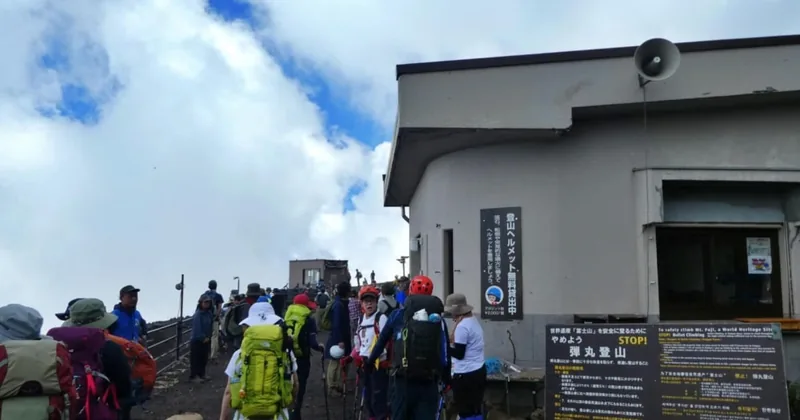
Two days, one hut night and the sunrise from near the summit, with the hut, meals, gear rental and fees arranged: the 2-day sunrise climb from Tokyo.
Check dates for the 2-day sunrise climb from TokyoHow do Mount Fuji mountain huts work?
You book a hut in advance, directly with the hut or through a tour, and separately from your trail entry. Expect a shared sleeping platform, a simple dinner and breakfast, early lights out and a very early wake-up.
- Booking: reserve as soon as the huts open bookings for the season; weekends and the peak of summer fill first. A hut booking is also what lets you pass the gate after 14:00.
- Where: most climbers sleep at the 7th or 8th station, high enough to make the summit before dawn, low enough to sleep. The Yoshida Trail has the most huts; Gotemba has the fewest.
- Sleeping: in peak season you share long platforms with other climbers, side by side, with a sleeping bag or futon. Earplugs help.
- Meals: an early, simple dinner and a breakfast, often packed to take with you when you leave in the night.
- Evening: lights out early in the evening, with wake-up in the small hours for the sunrise.
- Practical: huts sell water and snacks, toilets ask for a small tip, and there are no showers.
The hut night is usually the biggest single cost of a climb on your own; what else you pay for is listed in the rules and fees guide.
Where is the best place to watch the sunrise on Mount Fuji?
From the summit if you are there in time, or from the 8th or 9th station if you would rather avoid the crowds. Summer sunrise is about 4:30 to 5:00, and from anywhere high on the eastern side of the mountain the view is superb.
Goraiko (御来光) means the arrival of the light, and on a clear morning the sun rises out of a sea of clouds to the east. On the Yoshida and Subashiri trails, which face east, you can watch it from the trail itself or from outside your hut. On Fujinomiya, on the south side of the mountain, the best view is from at or near the rim.
The last stretch below the summit gets very crowded before dawn in peak season, with long queues of headlamps. If the summit at sunrise matters to you, leave the hut early and allow extra time; if it does not, watch from lower down and walk to the top afterwards, when the trail is quieter. Dress for the coldest hour of the day while you wait.
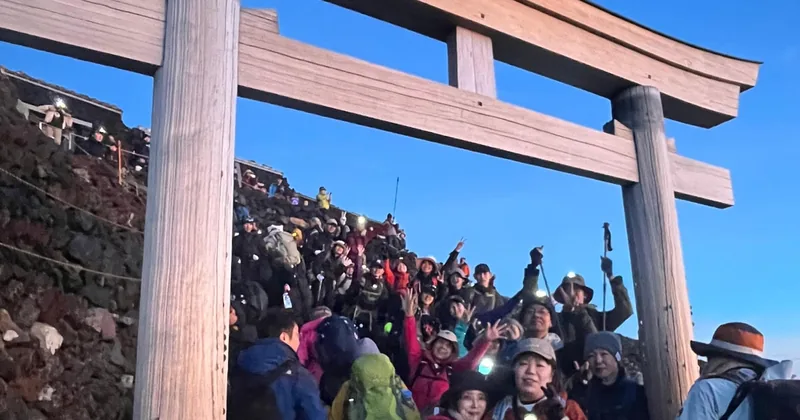
The 3-day guided hiking tour from Subashiri spends a first night in a lodge near the trailhead, then a hut at the 8th station, and watches the sunrise between the 8th and 9th stations, away from the summit crowds, before walking to the top. A hot spring waits at the end. Summer season only; rated 5.0 from 1 review so far, and full refund if you cancel up to 24 hours ahead.
Explore the 3-day guided Fuji hikeWhat does a two-day Fuji climb look like?
Start from the 5th station around midday, reach your hut in the late afternoon, sleep early, and set off again around 01:00 to 02:30 to be near the top for sunrise. You are usually back at the 5th station by late morning or midday on day two.
The times below are a typical plan for the shorter trails; on Gotemba everything starts much earlier. Before you start, spend about an hour at the 5th station to let your body adjust, and eat something. On the way up, walk more slowly than feels necessary and drink regularly.
Guided climbs follow a similar rhythm. The 2-day sunrise climb leaves Shinjuku at 06:30 (or meets at the Gotemba base at 09:00), climbs the Fujinomiya Trail past the Hoei crater weather permitting, and sleeps in a hut near the crater rim, about 20 minutes below the summit.
| When | What you do |
|---|---|
| Day 1, late morning | Arrive at the 5th station, rest about an hour, register and pass the gate |
| Day 1, midday to late afternoon | Climb 4 to 6 hours to a hut at the 7th or 8th station |
| Day 1, about 17:00 | Dinner at the hut, then early to bed |
| Day 2, about 01:00 to 02:30 | Wake up, headlamp on, climb to the summit or a sunrise spot |
| Day 2, about 4:30 to 5:00 | Goraiko, the sunrise over the clouds |
| Day 2, after sunrise | Crater walk if the weather allows, about 1 to 1.5 hours |
| Day 2, morning | Descend about 2.5 to 3.5 hours to the 5th station |
How cold is it at the top of Mount Fuji?
Even in August, the summit averages only about 6 °C, and it drops close to 0 °C before sunrise. Wind makes it feel much colder, so dress as you would for winter, whatever the weather in Tokyo.
The Japan Meteorological Agency's long-term averages for the summit show how different it is from the lowlands. Add the wind, which is often strong on the rim, and the hour you spend standing still before dawn, and the summit feels far colder than the number on the thermometer.
- Layers: a base layer, a fleece and a down or synthetic jacket, with your rain jacket on top as a windproof.
- Extremities: a warm hat, gloves and dry socks.
- While you wait: put everything on before you stop, not after you start shivering.
- Weather: summer thunderstorms, fog and strong wind are the summit's main hazards; if the weather turns, go down.
| Month | Summit average | Typical daily range |
|---|---|---|
| July | 5.3 °C | 2.8 to 8.0 °C |
| August | 6.4 °C | 3.8 to 9.5 °C |
| September | 3.5 °C | Colder as the season ends |
| January | -18.2 °C | Deep winter, trails closed |
How long does it take to come down Mount Fuji?
About 2 hours 40 minutes to 3 hours 35 minutes by the official estimates, depending on the trail. It is shorter than the way up, but hard on the knees, and many people find the descent the most tiring part.
- Yoshida: a separate descent path, wide and zigzagging, on loose gravel. Follow the signs for the Yoshida 5th station where the paths split, because Yoshida and Subashiri share the upper trail.
- Subashiri and Gotemba: long sandy runs where you can take big, sliding steps. Gaiters keep the grit out of your boots.
- Fujinomiya: the same path up and down, steep and rocky, so take it slowly.
- For every trail: trekking poles, tight laces, sunglasses and sun cream (there is little shade), and water, because the huts on the descent are few.
The trails are compared in detail in which trail to choose.
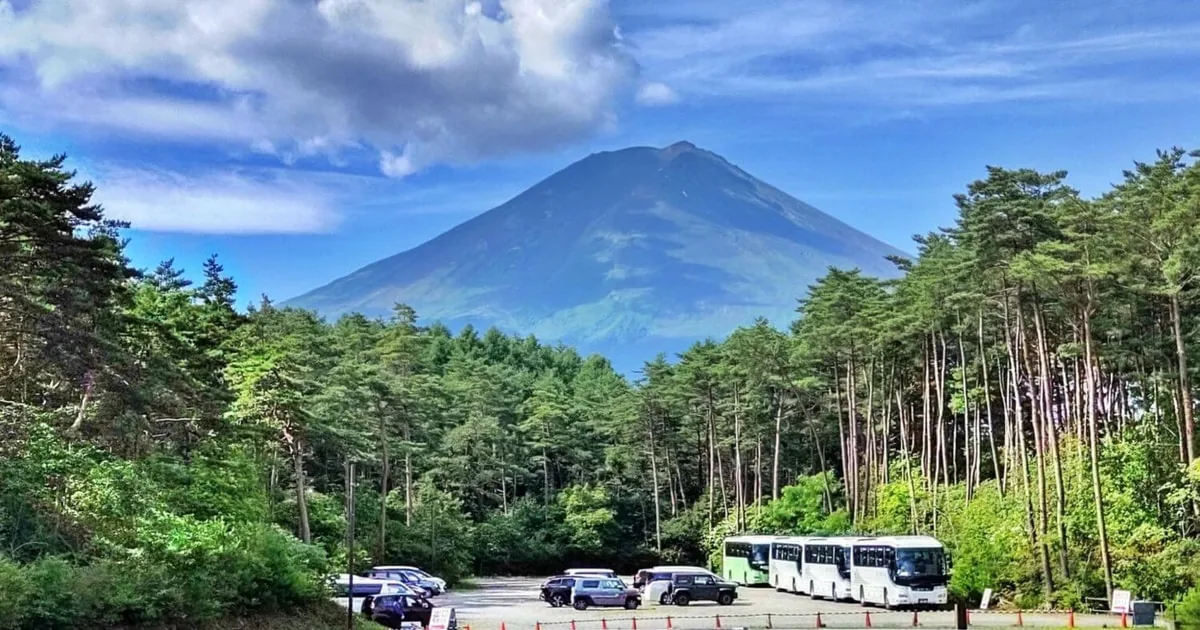
Is the crater walk (Ohachi-meguri) worth it?
Yes, if the weather is calm and you still have energy after the sunrise. The walk around the summit crater takes about 1 to 1.5 hours and passes Kengamine, at 3,776 m the highest point in Japan.
The rim walk is open during the season (in 2026, from 10 July to 10 September) and closes in strong wind, fog or snow. It goes up and down around the crater, on loose ground at the highest altitude of your trip, so treat it as an extra rather than a must. If you have a headache or feel sick, skip it and start down: descending is the best cure for altitude sickness.
Many climbers who reach the top on the Yoshida or Subashiri side only walk to Kengamine and back. Some guided climbs include the rim walk and some do not, so check the listing; the 3-day tour from Subashiri, for example, leaves it out. More on pacing and altitude is in how hard is Fuji.
Your own guide at your own pace, on the route you choose: the private 2-day summit climb, with the climbing fee included.
Check dates for the guided 2-day summit climbIs a guided sunrise climb worth it?
It is if you want the hut, gear, registrations and timing arranged for you, or if you have never hiked at altitude. You can also climb on your own; a guide is not legally required.
Only a handful of guided summit climbs are listed on GetYourGuide, and they have very few reviews so far: 5 for the 2-day sunrise climb, 2 for the private summit climb and 1 for the 3-day tour, all rated 5.0. Reviewers of the sunrise climb describe it as well planned, with a guide for a group of five and extra gear provided. All three run in the summer season only, so a booking now is for next year.
The three are compared side by side, with a checklist for climbing on your own, in with a guide or without. The day tours to the lakes and the 5th Station, which run all year, are on the homepage.
Frequently asked questions
What time is sunrise on Mount Fuji in summer?
About 4:30 to 5:00 in July and August. Plan to leave your hut in the small hours so you are in position, dressed for the cold, about half an hour before.
Do I need to book a mountain hut in advance?
Yes. Huts are booked separately from the trail entry and fill early on weekends and in peak season. A hut booking is also what lets you pass the 5th station gate after 14:00.
Where do you sleep when you climb Mount Fuji?
In a mountain hut, booked in advance. Most people sleep at the 7th or 8th station; some huts sit close to the crater rim, like the one used by the 2-day sunrise climb.
Is the summit crowded at sunrise?
Yes, in peak season the last stretch below the top queues up before dawn. Watching from the 8th or 9th station and walking to the summit afterwards avoids most of it.
Ready to book
Choose your hike
Check your date and the live price on GetYourGuide; the refund terms are shown on each option.
2-Day Sunrise Climb from Tokyo, Hut Stay
- Guided climb with one guide to six guests
- Hiking gear rental and a safety briefing
- Hut night near the top with dinner and breakfast
3-Day Guided Fuji Hike with Two Nights
A lodge night below, an 8th station hut, sunrise away from the summit crowds
Guided 2-Day Summit Climb, Your Route
- A professional mountain guide, just for your group
- The Mount Fuji climbing fee
- Transport as in the option you choose